


When to Give Your Baby Water?


Having a baby and caring for them takes careful attention and knowledge from parents.
On the journey of parenthood, plenty of questions come up — including when to give water to babies. Which drinks can you give your child? How much should your child drink at 1 year?
You will find the answers to these and many other questions in our article, where you will also learn what doctors think — including a gastroenterologist — about certain types of drinks for children.
Contents
- What do we need water for?
- Should you give babies water?
- Can newborns be given boiled water?
- “Dill water” for colic: are doctors for or against?
- How to offer water when starting solid foods
- How much water does a child need?
- Signs of thirst in children
- When it is worth offering more water
- Water temperature: cold or warm?
- Drinks for babies under 1 year
- Which cup to choose for a baby under 1 year
- Drinks and cups for children after 1 year
- Milk in your child's diet after 1 year
- Drinks to avoid depending on age
What do we need water for?
Water is a key component of the human body and makes up 75% of a baby’s body weight and 50-60% of the body weight of children, teenagers and adults.
It regulates body temperature, protects vital organs, helps nutrients be absorbed, is the medium for biochemical reactions and supports blood volume.
Should you give babies water?
The World Health Organization notes that breastfed babies do not need extra water, because breast milk is more than 80% water and provides all the fluid a baby needs.
The same recommendations also apply to formula-fed babies.
So if your baby is getting enough breast milk or infant formula, they do not need any extra fluid before 6 months.
These recommendations apply at any time of year.
Can newborns be given boiled water?
No, no water of any kind should be offered to a newborn.
There are several reasons why water is not recommended for a baby before solid foods are started:
- Water has no calories and takes up space in the stomach, which can lead to nutrient deficiencies and poor weight gain.
- Your baby’s kidneys are still maturing, and extra water can lead to an electrolyte imbalance. Large amounts of water increase the risk of hyponatremia.
- If your baby is breastfed, taking fluid from a baby bottle can increase the risk of so-called “nipple confusion”, where the baby starts to latch on shallowly, of an ineffective latch, of pain or cracked nipples in the mother and of poor weight gain in the baby, sometimes even of refusal behavior at the breast.
“Dill water” for colic: are doctors for or against?
Colic is a common problem in babies and causes parents a great deal of worry. One of the traditional remedies often recommended to ease it is dill water for babies.
But is it really effective? Let’s look at what doctors think.
What is dill water?
Dill water, also known as dill infusion or fennel water (some versions use fennel seeds, which have similar properties), is an infusion or solution made from dill seeds. It has a long history of use in folk medicine for easing various gastrointestinal problems, including gas and bloating.
It is commonly believed that dill water helps relax the muscles of the gastrointestinal tract, reducing spasms and making it easier to pass gas. This is thought to reduce the pain and discomfort caused by colic.
But to understand whether dill water for babies really does help reduce colic symptoms, or whether this treatment is better avoided after all, we asked for the opinion of pediatrician and pediatric gastroenterologist Kateryna Filatova:
«Studies show that dill oil has certain properties that may help reduce gas and ease colic symptoms in babies.
There is also a study on fennel possibly being slightly more effective than placebo.
Some researchers studied it in the context of a particular branded product containing fennel, so there may be a conflict of interest.
At the same time, there are reports that during breastfeeding fennel may even be dangerous.
Two breastfed babies were reported to have suffered nervous system damage after their mothers drank a herbal tea containing fennel.
All the studies point to the need for further research to determine more precisely how effective and safe dill water (fennel) is when used for medical and therapeutic purposes.
We do not know exactly the dose, the amount or how long it should be taken, so we cannot draw a conclusion about its effectiveness and safety.
It is also worth bearing in mind that this is extra fluid too, and it can have the same negative effects on a baby’s body as drinking water.
Fennel is certainly safe when taken by mouth in the amounts usually found in food. For the most part there is not enough evidence to know whether it is safe for children and adults when used in medicinal amounts.
So you need to be careful. Using dill water or dill essential oil to treat babies should be backed up by a consultation with a doctor, in order to protect your baby’s health.»
How to offer water when starting solid foods
You can offer water both at mealtimes and simply throughout the day.
Remember that breast milk or infant formula is the basis of your baby’s diet.
In the first months, your baby is getting to know solid foods and water. Learning happens step by step: water goes into the mouth, your baby holds it, swallows it — all of this supports the development of oral motor skills.
Learning is an important and lengthy process.
It is worth showing your baby again and again how adults drink water through the day and enjoy it. This is how the understanding develops that the drink we use to quench thirst and the one we prefer is water.
Which water should you offer your child?
- Regular bottled water;
- Table water;
- Bottled baby water (0+);
- Filtered water;
- Plain tap water is fine if your city or country has official guidance that such water is safe.
Which water must not be offered?
- Medicinal and medicinal-table mineral water;
- Water from a well or a spring that has not been properly certified.
How to store water?
When buying water, check the production date.
It is important that the water container is kept in a place protected from direct sunlight. Also, water should not be stored near heaters or radiators.
Once opened, water is best used up within 2-3 days. Water that is kept in a bottle must not come into contact with saliva, food and so on.
If you use water from a water cooler, watch the cleanliness of the pump and of the cooler itself carefully; if needed, it is better to boil such water before drinking.
How much water does a child need?
You will often come across recommendations that children must be given a certain amount of water per day.
But are there real daily water norms for a child that will tell you exactly how much a child at 1 year or older should drink?
Or should you go by other indicators instead?
The effect of too much water in a child’s diet
Sometimes parents, in trying to follow certain recommended water intake norms, can even harm their child.
Drinking too much water can have a negative effect on a child’s body. It can lead to a condition known as water intoxication or hyponatremia, when the level of sodium in the blood drops.
Symptoms can include nausea, vomiting, weakness, disorientation, seizures and even loss of consciousness.
Water should be given especially carefully to babies and young children, because their kidneys are not yet fully developed and cannot efficiently remove excess fluid.
Factors that affect how much water is consumed
Recommended water intake norms should be taken as approximate guides, because every child is unique.
The amount of water a child needs depends on many factors, such as the season, age, level of physical activity and state of health.
Approximate water intake norms for children of different ages
Age is an important indicator for a child’s daily water norm. That is, the amount of water a child should drink at 1 year and younger will be different.
According to the recommendations of authoritative sources, the approximate daily water norms for children are as follows:
- 6-12 months: approximately 120-240 ml of water per day;
- 1-3 years: approximately 950 ml of water per day.
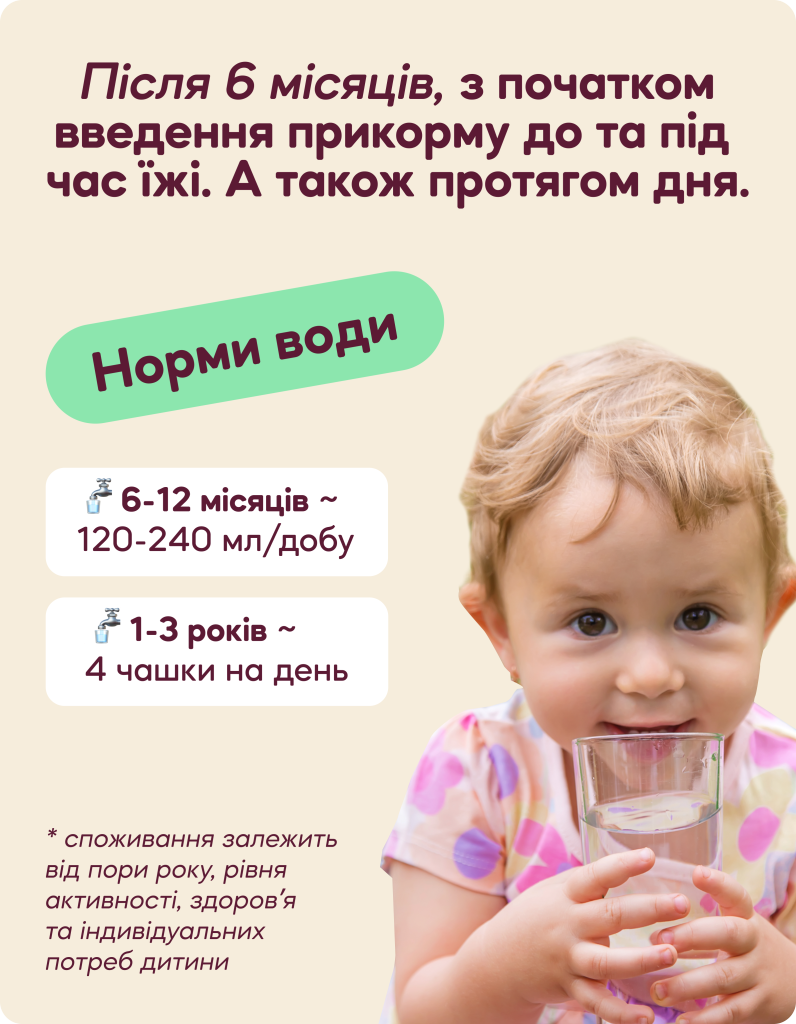
These recommendations assume a usual level of physical activity and can change depending on the climate, state of health and other factors. It is important to watch for signs of thirst, such as a dry mouth, infrequent urination and tiredness.
Remember that children need more water during exercise or in a hot climate. It is also important that children need to drink water in any weather, even in winter.
Encourage but do not force your child to drink water before, during and after physical activity, even if they do not feel thirsty.
This will help prevent dehydration and maintain proper hydration.
Signs of thirst in children
Thirst is a natural mechanism of the body that signals a need for extra fluid. For children, who grow quickly and are very active, thirst is an important indicator of their need for water.
But children cannot always clearly express or recognize their thirst, and this can lead to dehydration.
To avoid this, you should know how to recognize the signs of thirst and keep track of how much water your child needs per day.
Dry mouth and lips
Children may complain of a dry mouth, or their lips may look cracked and dry, if this is not caused by weather conditions such as wind or frost.
Reduced urine output
Thirst is often accompanied by urinating less often.
In very young children, you may notice fewer diaper changes than usual.
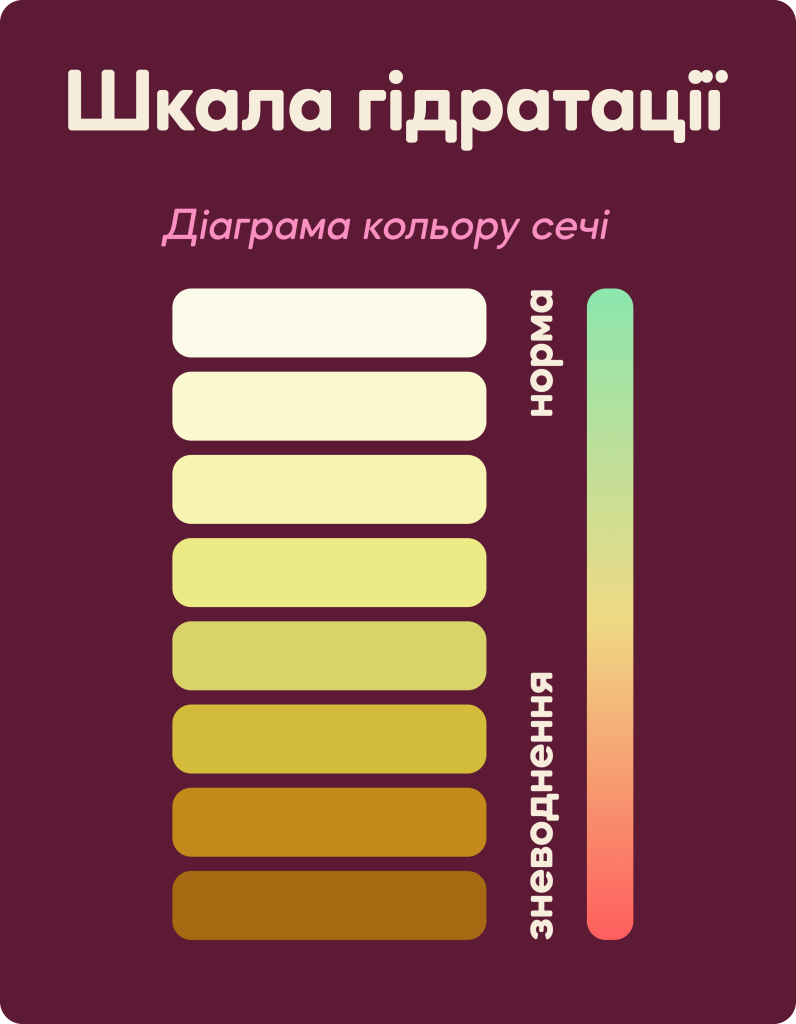
Change in urine color
Urine should be a light shade – lemon, pale yellow, sometimes almost clear.
If the urine is a dark shade – dark yellow, sometimes even orange – then your child is not getting enough fluid.
Feeling tired or sluggish
Children may become less active and show signs of tiredness or sleepiness.
Thirst can lower energy levels, because the body is trying to conserve water.
Complaints of headache
Children may complain of a headache, which is a common symptom of dehydration and thirst.
Feeling dizzy
Dizziness or unsteadiness can happen because of a drop in blood volume linked to not drinking enough water.
Irritability or mood changes
Not having enough water in the body can affect your child’s mood, making them irritable or less attentive.
Reduced appetite
Thirst can lead to a reduced appetite, because the body focuses on conserving fluid rather than on digesting food.
Sunken fontanelle
In babies, a sign of dehydration may be a sunken fontanelle.
Parents should watch their child closely to avoid possible dehydration.
When it is worth offering more water
Ensuring proper hydration is an important part of supporting your child’s health.
Although thirst usually signals the body’s need for water, there are certain situations when children should be offered more water, even if they show no clear signs of thirst.
During periods of increased physical activity
During active play, sports or other physical exertion, children lose more fluid through sweating.
This is especially true for children who do sports outdoors or in a warm climate.
- Offer water before, during and after physical activity.
In hot weather
In the heat, the body loses fluid faster through increased sweating.
Children may not realize they need to drink more water, which can lead to rapid dehydration.
- Offer water more often than usual, especially while outdoors, and encourage drinking by using different fun water bottles or sippy cups.
During illness
During illnesses, that come with a raised body temperature or fever, the body uses more fluid to regulate temperature.
This can cause dehydration.
- Offer your child water or other fluids, such as oral rehydration solutions for children, if needed.
- Offer fluids in small amounts but regularly, to prevent vomiting.
Gastrointestinal infections that cause vomiting or diarrhea can quickly lead to a significant loss of fluid.
Restoring fluid balance in such cases is critically important.
- Offer oral rehydration solutions or plain water in small amounts, to gradually restore fluid levels.
With Constipation
Water will not solve the problem of constipation, but not drinking enough water, which leads to thirst, can lead to problems with the formation of stools.
Water during travel or in places with low humidity
A flight or being in an environment with low humidity, for example in air-conditioned rooms, can lead to fluid loss through breathing.
- Offer your child water to drink before and after a flight, and also while in places with low humidity.
Understanding the situations when you need to offer more water will help you avoid dehydration and the complications linked to it.
It is important not only to teach children to drink water regularly, but also to be alert to those situations when the need for water may increase.
Water temperature: cold or warm?
You often hear that babies should not be given cold water.
In fact, you can offer your baby water at any temperature that is comfortable for them. The choice of temperature depends more on their preferences and on the situation.
Drinks for babies under 1 year
The first year of your baby’s life is a crucial period, when the foundations are laid for healthy development and balanced growth.
During this time babies gain new experiences and get to know different tastes.
However, parents often find it hard to work out when and how to give water to their baby without harming their health.
Apart from breast milk and infant formula, the only drink before 1 year should be water.
Which cup to choose for a baby under 1 year
When you start solid foods, offer water in an ordinary open cup or a straw cup.
Using this kind of cup helps develop the oral motor skills of the mouth, which matters for speech development and for eating.
What to look at when choosing a cup for your baby:
- No valve. Avoid cups with valves that make them “non-spill”, such as cups with hard or soft spouts, and also 360 cups. They do not teach the skill of drinking, and in some cases they can affect the latch at the breast.
- Choose cups or glasses made of safe materials, such as food-grade silicone or safe plastic. If you have a glass cup, do not leave your baby alone with it, to avoid injury.
- For the youngest babies, choose cups with two handles or with none, as babies may find it hard to hold a cup with a single handle.
- Experiment with the size of the cup, because sometimes babies find it easier to hold a small cup in their hands.
- When choosing a cup, it is important to pay attention to the materials it is made of. Cups should be made of safe, non-toxic materials that contain no BPA or other harmful substances.
- The design of the cup also matters: ergonomic handles and a non-slip coating can make learning easier for your baby.
- When choosing a straw cup, pay attention to the flow of water: pick one where the water comes out easily, without too much effort. Also, for the first attempts, choose straws of medium thickness that are not too long.
How do you teach your baby to drink from a cup?
Teaching your baby to drink from an open cup is an important stage in their development, which helps build independence and coordination of movement.
This process may take patience and a gradual approach, but with methods that work you can make learning fun and avoid stress for your baby.
- Fill the cup with a small amount of water and hold it out to your baby so that they can take it in their hands themselves. Once your baby reaches for the cup, help them bring it to their mouth and steady it on the lower lip, then tilt the cup slightly so the liquid gets into their mouth.
- At the beginning of learning, your baby may lick the cup, spill water and cough — this is all normal. In time your baby will learn to close their lips around the cup and there will be fewer spills.
- Drink from a cup together with your baby, so they can see how it is done. Babies learn by watching, so your demonstration will be very helpful.
- Learning can take some time, so be patient.
- Offer your baby the cup at every meal and in between meals. The more your baby practices, the sooner they will learn to drink from a cup.
How to teach your baby to drink through a straw?
Learning to drink from a cup with a straw is a useful and important skill, especially in situations where you need to quench thirst away from home.
Some babies intuitively understand how to drink from a straw, but in most cases they need to be taught:
- Pour a small amount of water into a cup and bring it to your baby’s mouth. If your baby takes the straw into their mouth and tries to suck up the liquid, great — offer the straw cup and the open cup, alternating between them at every meal and away from the table.
- If your baby doesn’t understand how to suck up liquid, try giving something thicker, for example yogurt, breast milk or formula. These flow more slowly and stimulate the sucking reflex.
- You can also use the “pipette” method. Dip the straw into water and cover the top opening with your finger so the liquid stays inside. Bring the straw to your baby’s lips and release it slightly so the water goes into their mouth. Sometimes babies simply need to realize that there is liquid in the straw and that they need to suck it.
- You can also use special training cups with straws. Fill the cup about halfway with water. At this point the straw should stick out of the cup by about 2–3 cm. Bring the cup to your baby’s mouth and place the straw between their lips — on the front part of the tongue. Press lightly on the cup so the water rises up the straw. Your baby will realize that there is water in the straw, will close their lips around it and suck up the liquid.
Drinks and cups for children after 1 year
It’s worth continuing to give your child water, as water is the most important drink for children of any age. It provides hydration without adding extra calories or sugar.
Give children clean drinking water throughout the day, especially with meals and after physical activity.
The preferred container for drinking water is still an open cup or a cup with a straw, as these best support learning the skill of drinking and the development of oral motor skills of the mouth.
From the age of 1 year, you can use bottles or cups with straws of a larger diameter.
Milk in your child’s diet after 1 year
It’s worth noting that before 1 year milk can be offered to your baby in dishes, for example in porridge or omelets.
Only after the first year of life can children be given cow’s milk or other pasteurized milk of animal origin as a drink.
However, it’s important to keep an eye on portions of milk and dairy products. It is recommended to give children aged 1 to 4 years about three servings of dairy products a day, where one serving of milk is 100–120 ml.
The fat content of milk plays an important role, especially for brain development and your child’s overall growth. Choose higher-fat milk: for children under 5, milk with more than 1% fat, and after 5 you can offer low-fat (1%) milk.
Dairy products offered to children under 5 must be pasteurized or ultra-pasteurized.
Besides animal milk, you can use alternatives such as soy, almond or oat milk. However, keep in mind that their nutrient content is significantly lower than that of animal-based options.
So if there is a wish or a medical indication to use plant-based milk, choose products fortified with vitamins and minerals, in particular vitamin D and calcium.
Drinks to avoid depending on age
A balanced diet, including the choice of drinks, is extremely important for children’s development. At the same time, some drinks can have a negative effect on their health, development and eating behavior.
Let’s look at which drinks children of different ages should avoid:
Before 6 months
- All drinks other than breast milk and infant formula for formula feeding.
Before 1 year
- Any drink other than breast milk, formula or water.
- This also includes various homemade drinks, such as compotes and uzvars.
- And if added sugar or other sweeteners were used to make them, they should only be offered from 2 years of age.
Under 2 years
- Drinks with caffeine, such as green tea, black tea, cocoa
- there is no safe limit of caffeine for children, so any caffeinated drinks should be avoided in a child’s diet
- Herbal teas
- many herbal teas have not been studied enough for their safety in children. Most studies focus on adults, and there is not enough information about how they affect children.
- so, given the potential risks, herbal teas are not recommended for children without talking to a doctor first.
- Drinks with added sugar
- children under 2 years should avoid any drinks with added sugar. This includes:
- flavored milk
- juice
- sparkling/still sweetened drinks, since they have the same effect on a child’s body as sugar.
- sometimes there are situations where a doctor may prescribe juice for a younger child for medical reasons, for example for constipation. In that case the potential harm from the condition outweighs the risks linked to drinking juice. But it is important to remember: this decision is made by a doctor after examining your child
- children under 2 years should avoid any drinks with added sugar. This includes:
Under 5 years
- Any unpasteurized drinks
- such drinks include:
- unpasteurized milk drinks
- freshly squeezed juices
- apple or pear cider
- and others.
- drinking unpasteurized drinks can be a serious risk to health, especially for young children.
- this is because children’s immune systems are still developing, so they can be more vulnerable to the disease-causing microorganisms that may be present in unpasteurized drinks. As a result, this can lead to serious illness.
- such drinks include:
- Rice milk
- because of the arsenic content in rice, rice milk is not allowed for children under 5 years.
- arsenic is a natural element that can be present in soil, water and air. Rice and products made from it, such as rice milk, may contain arsenic. The reason is that rice, as a grain, is able to absorb more arsenic from soil and water than other cereal crops.
Under 12 years
- Coffee
- this drink contains a significant amount of caffeine, which is a stimulant of the central nervous system.
- caffeine can cause increased excitability and irritability in children, making them hyperactive and causing difficulties with concentration and behavior problems.
- besides that, caffeine can have a negative effect on the quality and length of your child’s sleep, which is critically important for their development and overall health.
- some studies indicate that excessive intake of caffeine may affect how the body absorbs calcium, which is important for building strong bones in children.
As for drinks such as “ReO” water for children or others that have a medicinal purpose, they should be offered only as prescribed by a doctor.
Sources:
- https://www.who.int/news-room/questions-and-answers/item/breastfeeding
- https://publications.aap.org/aapbooks/monograph/734/chapter-abstract/11477553/Water-and-Hydration?redirectedFrom=fulltext
- https://elht.nhs.uk/application/files/6316/6022/5455/Water_during_infancy_FAQ_final_1.pdf
- https://health.clevelandclinic.org/gripe-water-for-babies
- https://nutritionsource.hsph.harvard.edu/water/
- https://www.healthychildren.org/English/healthy-living/nutrition/Pages/Choose-Water-for-Healthy-Hydration.aspx
- https://www.healthdirect.gov.au/hydration-tips-for-children
- https://www.nhs.uk/conditions/baby/weaning-and-feeding/drinks-and-cups-for-babies-and-young-children/
- https://www.healthychildren.org/English/healthy-living/nutrition/Pages/recommended-drinks-for-young-children-ages-0-5.aspx
- https://www.nhs.uk/conditions/baby/weaning-and-feeding/drinks-and-cups-for-babies-and-young-children/
- https://health.clevelandclinic.org/is-caffeine-bad-for-kids