


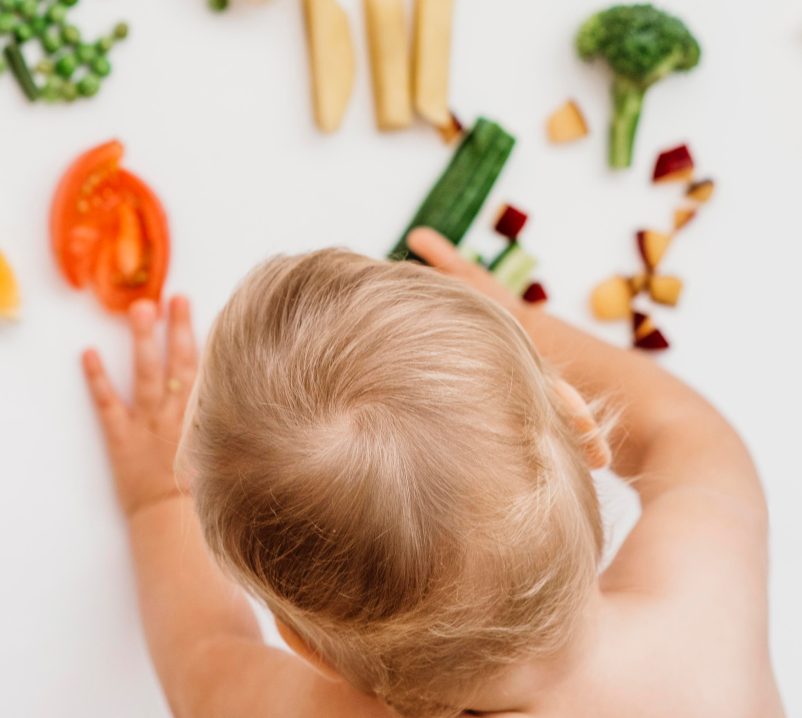
Baby-Led Weaning (BLW): From Theory to Practice


When you are introducing solid foods, it matters not only what we offer your baby, but also how it happens, because this affects your child’s physical and mental development, as well as the way their eating behavior is formed and their overall attitude to food in the future.
Although there is no single method of introducing solid foods that is right for everyone, many families choose baby-led weaning (BLW) because of its convenience and its many positive aspects.
In this article we will look at the features of the BLW method and help you work out whether it is right for your family.
Contents
- What is baby-led weaning (BLW)
- The history of baby-led weaning
- The main principles of baby-led weaning
- The benefits of baby-led weaning
- Concerns about BLW
- BLISS: The evolution of baby-led weaning (BLW)
- When to start BLW solid foods
- How to start BLW solids: what to pay attention to
- How to tell the gag reflex from choking
- Breastfeeding/infant formula and solid foods
- How often to offer solid foods
- Key principles of serving food safely
- Foods to avoid in your child's diet
- Examples of first foods and plates in BLW
- Conclusion
What is baby-led weaning (BLW)
Self-feeding, or BLW (from the English baby-led weaning) is a method of introducing solid foods in which the traditional stage of spoon-feeding puréed food is skipped.
Instead, your baby is given adapted foods from the family table right away, and decides for themselves what and how much to eat, and how to explore the food.
The history of baby-led weaning
Self-feeding is more than just introducing solid foods as finger foods, and it is not a modern trend or a new invention.
Similar approaches were used in traditional cultures, where children took part in family meals and ate on their own from an early age.
The method became popular thanks to Gill Rapley, a nurse and breastfeeding consultant from the UK.
In 2008, together with Tracey Murkett, she published the book “Baby-led Weaning: Helping Your Baby to Love Good Food”, which describes the principles and practical aspects of baby-led weaning in detail.
After the book came out, the ideas of self-feeding began to spread quickly among parents all over the world.
Today it is a recognized method of introducing solid foods in many countries, including the UK.
The main principles of baby-led weaning
- Your baby eats together with the family at the family table right away, getting adapted food from the shared menu, apart from foods that are not allowed. From the start, your baby decides what and how much to eat from what is offered. They are not topped up with a spoon — they eat on their own.
- Active exploration of food is encouraged: your baby is allowed to squash, smell, lick and play with the food offered. Food is served in different shapes, sizes and textures to match their age and chewing skills, following the rules of safe serving. For runny foods such as cereals or yogurt, you can offer a spoon.
- The concept of baby-led weaning does not conflict with responsive feeding. If your baby is interested in the food but cannot manage the consistency or the shape, you can help while leaving them in control: put some food on a spoon, bring it close to their mouth and wait until your baby reaches for it themselves. The same goes for serving finger foods.
The benefits of baby-led weaning
An easier feeding process
Baby-led weaning makes feeding simpler, saving time and money, because your baby eats the same food as the whole family, just in an adapted form.
That means fewer separate dishes and, most likely, lower spending on special baby food.
On top of that, sharing the same meals means your baby gets used to the family diet from an early age.
Social development and stronger family bonds
Shared family meals, which are at the heart of the self-feeding concept, support social interaction and copying the eating habits of adults.
During shared meals, children learn to interact with others, to watch their behavior, to chew and to communicate.
It supports the development of motor skills
Food with different textures and consistencies helps children learn to chew, and develops the jaw and tongue muscles, which is an important part of developing the motor functions of the mouth that directly affect speech skills.
Handling foods of different sizes and shapes also trains fine motor skills and coordination.
The effect on your baby’s sensory development
Getting to know different consistencies, textures, shapes and sizes of food is a great boost for developing sensory skills.
When your baby is allowed to squash, smell, lick and play with food, it helps them explore the world using all their senses, which is good for your baby’s overall development.
The foundation of healthy eating behavior is laid
Your baby’s autonomy is another one of the key principles of baby-led weaning (BLW).
When your baby has the chance to choose for themselves what and how much to eat from what is offered, it builds their independence and confidence in their own actions.
This way, your baby learns to recognize their own feelings of hunger and fullness, which is a key skill for building healthy eating behavior
Early exposure to different textures and flavors encourages openness to new foods, which may reduce picky eating in the future.
It’s worth understanding that these positives can also be achieved with traditional purée-based solid foods, if you follow the principles of responsive feeding, offer a variety of flavors and textures even in purée form, and move on to finger foods in good time.
It’s also important to involve your baby in family meals, letting them watch and take part in the process.
Concerns about BLW
It will be messy
Traditional solid foods in purée form don’t guarantee perfect order either, because it’s natural for babies to explore food in different ways, including with their hands.
The good news is that with experience and developing skills your baby will become more skillful and tidier.
You need teeth to eat finger foods
As a rule, the incisors come through first; they help with biting, but not chewing.
Molars – the main chewing teeth – mostly appear after 1 year.
You can notice your baby’s first chewing movements as early as 4-5 months, and a full set of teeth forms no earlier than 2-3 years.
During this period babies use their gums effectively to break down and chew food, but it’s important to offer food in a safe form.
So, to eat solid foods as finger foods, you don’t need to wait for your baby’s teeth to appear.
A baby’s digestive tract isn’t ready for finger foods right away
Most babies go through a phase when they often bite off large pieces, which can frighten parents. In fact, this is good for developing the chewing and swallowing reflexes.
As for the effect on the digestive tract, even if a large piece of food reaches the stomach, it will do no harm.
Your baby’s stomach grinds food down to a size of 3-5 mm before it passes into the duodenum, and it handles this task easily.
It’s important that food is soft and safe, to avoid choking.
There’s no need to worry if you see pieces of food in your baby’s stools, because this is part of the process of learning and of your baby’s digestive system adapting to whole foods.
The family’s diet may not suit your baby
The quality of nutrition for a baby who gets their solid foods from the family table largely depends on the whole family’s diet.
However, closer to 1 year, your baby will start showing interest in the food on your plate anyway and sooner or later will join the family table.
So starting solid foods is a great opportunity to make your own diet healthier.
And foods like salt or sugar can be added to your own dishes directly on your own plate.
A higher risk of choking
Studies show that when general safety rules during meals are followed, including safe serving, there is no difference in how often choking happens between babies introduced to solid foods with the BLW method and those introduced with traditional spoon-feeding.
Whichever method of starting solids you choose, it’s important to serve food according to the safe serving rules and to follow other safety measures during meals.
A higher rate of nutrient deficiencies
According to the recommendations, any type of solid foods should include iron-rich, varied and high-energy food from the very start.
By following these recommendations, you can significantly reduce the likelihood of deficiencies, in particular of iron and zinc.
To solve the potential problems of typical BLW, such as insufficient nutrient intake and the risk of choking, the BLISS method was developed.
It offers a more structured approach to choosing foods and serving food safely.
BLISS: The evolution of baby-led weaning (BLW)
The BLISS method (Baby-Led Introduction to SolidS) is a modification of the traditional BLW method.
This approach was developed as part of a randomized controlled study that looked at the effect of BLW solid feeding on health and addressed the main concerns many health professionals have about this approach to feeding.
In addition to the basic BLW rules, parents were given specific training on:
- Foods high in iron;
- High-energy foods;
- The dangers of choking.
So this method has the following main changes:
- Foods high in iron should be offered at every meal;
- High-calorie foods should be offered at every meal;
- Fruit or vegetables should be offered at every meal;
- There should be clear guidance on the right texture and shape of food to reduce the risk of choking.
When to start BLW solid foods
Most respected organizations, such as WHO, the American Academy of Pediatrics and others, recommend starting solid foods at around 6 months.
Besides that, before you start it’s worth working out whether your baby shows signs of readiness for BLW solids, namely:
- They can sit on their own or with minimal support, and have good control of their head and neck movements;
- While sitting, your baby can lean over, reach for an object with their hand, grab it and bring it to their mouth;
- They have an interest in food, that is, they actively watch when adults eat and open their mouth when a spoon is brought closer.
How to start BLW solids: what to pay attention to
The right body position
Your baby should sit upright in a high chair or on an adult’s lap.
Their position should be stable so that they can move their arms freely.
Feeding your baby lying down, reclined or on their tummy is dangerous!
Start by getting acquainted
Don’t worry if your baby eats little or refuses some foods.
Exploring food with their hands is one of the stages of getting to know and accepting food. Sometimes babies need more than 10 tries to get used to a new food.
It’s completely normal for babies to pull funny faces when they try new food.
Such facial expressions can show different emotions: your baby may be surprised, puzzled or unsure about the new taste.
Watch your baby
It’s best to offer food when your baby is not too tired or too hungry, because feeling that way will get in the way of fully learning to eat and exploring food.
Make the atmosphere at the table a happy one
Talk to your baby about the food you are eating: its color, taste, smell or texture.
Show them how you chew and enjoy your food. Let your baby eat at their own pace, without rushing them.
Don’t distract your baby from eating
Keep distractions to a minimum.
At mealtimes, don’t sit your baby in front of a TV, phone or tablet.
Never leave a baby who is eating on their own
Always watch your baby while they eat.
This will help prevent choking.
Make sure the food is safe
Food should be the right size and texture to avoid choking, and it should not be too hot, to avoid burns.
First aid for choking
Learn to tell the difference between when your baby is gagging and when they are choking and need you to act.
These tips will help make starting solid foods pleasant and comfortable.
How to tell the gag reflex from choking
The gag reflex (gagging) is a normal reaction of the body that protects against foreign objects getting into the airways.
It shows up as a strong contraction of the muscles at the back of the throat, which can cause a feeling of nausea or vomiting.
When gagging happens, the jaw drops and the tongue pushes forward. Breathing continues, and the airways stay clear.
In babies and young children the gag reflex is especially common while they are learning to eat different textures and types of food.
It works as a protective mechanism, making sure that large or poorly chewed pieces of food do not get into the airways.
This reflex comes with loud sounds, and your baby’s skin may turn red while it happens.
Although the gag reflex can be unpleasant, it is usually not harmful and it lessens over time, as a person gets used to eating a variety of foods.
Choking is a condition where the airways are blocked.
Some of the signs of choking include:
- gasping for air
- blue color around the lips or eyes
- wheezing
- being unable to make a sound, for example to cry
Before you start solid foods, it is essential to learn first aid for choking:
Breastfeeding/infant formula and solid foods
The American Academy of Pediatrics and the WHO recommend breastfeeding as the only source of nutrition for a baby for the first 6 months.
After starting solid foods at around 6 months, it is worth continuing breastfeeding until two years or beyond, if you and your child wish.
Breastfeeding has many benefits for both mother and baby, after six months and beyond.
It also provides the balance of nutrients your baby needs.
Under 1 year, breastfeeding or infant formula remains the main part of feeding. So you should not deliberately replace one milk feed with solid foods.
It is better to watch your baby, because as they grow they will eat more solid foods. Milk feeds will decrease gradually and naturally, closer to 1 year of age.
This recommendation applies to all types of solid foods, including BLW.
Some babies are more willing to explore food when they are not too hungry, and others are the opposite, so a milk feed, breast or formula, can be 2–1.5 hours or even 30 minutes before solid foods — it is worth deciding this timing individually.
It is also worth offering your baby a milk feed right after solid foods, if they show signs of hunger.
How often to offer solid foods
Under 1 year, solid foods should not push out breastfeeding or infant formula, because they are the main source of energy at this age.
Start solid foods with a small amount of food and gradually increase how often you offer them, guided by your baby’s appetite and needs.
The WHO suggests this number of meals:
- 6–8 months — 2–3 times a day
- 9–23 months — 3–4 times a day, and there can also be 1–2 nutritious snacks if your child needs them
Key principles of serving food safely
To make feeding comfortable and safe, you need to follow the rules for serving food safely.
This is important to know not only for parents who have chosen baby-led weaning (BLW), because closer to 1 year all babies move on to food in pieces, and a high risk of choking remains until 4-5 years.
The most dangerous foods, the ones that increase the risk of choking, have these features:
- Round.
- Hard.
- Smooth and slippery.
- Chewy and sticky.
- Small.
Foods with the highest risk of choking for children under 4-5 years of age:
- Raw hard vegetables and fruits in large pieces (for example, apples and carrots).
- Whole round berries, grapes, cherry tomatoes, cherries and so on.
- Nut butter on a spoon or spread in a thick layer.
- Whole nuts, large seeds and large pits.
- Large tough pieces of meat.
- Citrus fruits with the membrane on.
- Legumes such as chickpeas and peas, and also pomegranate seeds and corn kernels served whole.
- Fish and meat with bones.
- Sushky (dried bread rings), rusks, hard cookies, potato chips, popcorn.
- Hard candies, lollipops, chewy candy, marshmallows, toffees and so on.
- Hot dogs and sausages that are not cut lengthways.
To make dishes and foods safe, it is important to follow these rules:
- Do not mix pieces and purée in one dish until your child has learned to chew confidently.
- Remove tough skins and large pits/seeds.
- Raw, hard and fibrous vegetables (apple, pumpkin, carrot, beet (beetroot) and so on) need to be cooked until soft, and grated or cut into thin matchsticks when raw. If you can easily squash the food between the pads of your fingers, then it is soft enough and your child will be able to do the same with their gums.
- Round and oval foods smaller than or about the size of an adult OK sign 👌 (cherry tomatoes, grapes, olives, cherries, strawberries, large blueberries, eggs, kiwi and so on) should be cut into 4-6 pieces, not into 2.
- Small round and oval foods (peas, small blueberries, currants, chickpeas and so on) need to be squashed.
- Long foods with a round shape (carrot, banana, sausages, cucumbers, shrimp and so on) should be cut into half-moons or lengthways, so that the cut is no longer round.
- Cook meat until soft and cut it across the grain. Remove the bones. You can also serve meat as soft patties cut into sticks, or as ground meat.
- Go through fish carefully for bones and remove the skin.
- Nuts, peanuts and large seeds should be ground into crumbs and added to dishes.
- Nut and seed butters should be added to dishes and mixed in thoroughly, or spread in a thin layer.
- Grate hard cheese and add it to dishes, or cut it into thin slices/matchsticks; do not serve it in cubes.
- Peel citrus fruits and remove the membrane and the seeds.
- Soak dried fruit in boiling water, chop it finely and add it to dishes.
- Cook pasta, varenyky, pelmeni and so on until fully cooked through (avoid al dente and undercooked dough).
- Soft, fresh bread needs to be dried out before serving.
- Chop herbs well and add them to dishes. Leafy vegetables such as spinach or sorrel can be served separately, but after being stewed.
Foods to avoid in your child’s diet
Besides foods served in an unsafe way, there are some other foods that need to be avoided in the diets of babies and young children because of their potential danger. These foods include:
- Honey. It may contain botulism spores, which are dangerous for children under 1 year. In general, honey counts as added sugar, which is recommended to be avoided until at least 2 years.
- Salt. Until at least 1 year, you should not add salt to dishes, and you should limit foods with added salt (cheese, bread and so on).
- Sugar. Not recommended for children under 2 years because of the risk of tooth decay and of forming poor eating habits. Honey, juice and syrups are also types of added sugar.
- Cow’s milk and plant-based milks as a drink before 1 year. However, these products, apart from rice milk, can be used in small amounts as part of dishes.
- Rice milk. Children under 5 years should not be given drinks or dishes made with rice milk, as it may contain too much arsenic.
- Raw or undercooked eggs, meat, fish and other animal products for children under 5 years. They may contain salmonella, E. coli and other pathogens that can cause food poisoning.
- Unpasteurized milk and products made from it, and mold-ripened cheeses, for children under 5 years. These may also contain pathogens that can cause food poisoning.
- Fish high in mercury, such as shark, swordfish, marlin and bluefin tuna.
- Tea, including herbal tea, coffee and cocoa. They contain caffeine, which has a negative effect on a child’s body, and also substances that interfere with iron absorption.
- Sweeteners, including stevia. Their use in children’s diets is not recognized as safe.
Examples of first foods and plates in BLW
When offering foods in self-feeding to a baby at 6 months of age, the food should be big enough for your baby to grab it easily.
The recommended size is one that lets your baby hold the food in their fist, leaving a part to bite.
Later, closer to 9 months, the food should still be big enough for your baby to grab easily, but you can offer smaller pieces to practice the pincer grasp – picking up small objects.
Serve food as small cubes or pieces that your baby can hold between their thumb and index finger. The pieces should be about 1–2 cm.
BLW is not only about solid foods in pieces.
There is also room in it for liquid dishes from the family table, which you can offer along with a spoon or let your baby dip their hands into the dish and feed themselves that way.
Conclusion
BLW (baby-led weaning) is a wonderful way to introduce your baby to food, developing their motor, sensory and social skills.
It can give your baby autonomy and the chance to actively explore new tastes and textures.
However, it is important to keep things safe, to offer a variety of foods and to enjoy meals together.
Remember that every child is unique, so be flexible and listen carefully to their needs, including in the choice of method for starting solids.
Sources:
1. https://www.pregnancybirthbaby.org.au/the-first-1000-days
2. https://www.who.int/publications/i/item/9789240081864
3. https://smaki.pub/product/blw-prykorm-iak-dopomohty-dytyni-poliubyty-korysnu-izhu/
4. http://www.rapleyweaning.com
5. https://www.nhs.uk/conditions/baby/weaning-and-feeding/babys-first-solid-foods/
8. https://health.clevelandclinic.org/baby-led-weaning
9. https://health.clevelandclinic.org/benefits-of-sensory-play-ideas
10. https://www.ellynsatterinstitute.org/how-to-feed/the-division-of-responsibility-in-feeding/
11. https://www.unicef.org/parenting/food-nutrition/7-tips-winning-over-picky-eater
12. https://www.ncbi.nlm.nih.gov/pmc/articles/PMC8178105/
13. https://www.cdhp.org/can-babies-chew-without-teeth/
15. https://bmcpediatr.biomedcentral.com/articles/10.1186/s12887-015-0491-8
21. https://www.who.int/health-topics/complementary-feeding
22. https://www.cdc.gov/nutrition/infantandtoddlernutrition/foods-and-drinks/choking-hazards.html