


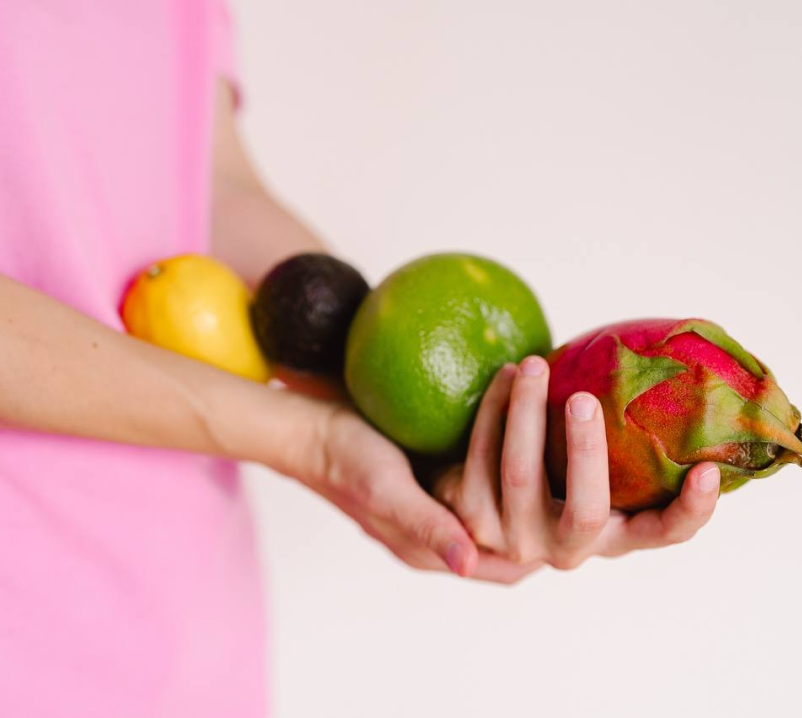
100+ First Solid Foods


As soon as your baby starts showing an interest in food, parents often worry about where to start with solid foods.
To make this process easier, we have put together this article to help reduce parents’ anxiety and let you start solid foods easily and without mistakes.
Contents
- Why 100 first foods?
- The best food to start solids with
- What the Healthy Eating Plate is
- Starting solid foods
- Water when starting solid foods
- Foods and drinks to avoid
- How to reduce the risk of iron deficiency anemia
- Allergenic foods
- Possible non-allergic reactions to new foods
- What is the difference between allergic reactions and irritation
- Are there foods that can cause diarrhea or constipation
- Your baby's digestive system readiness for a variety of foods
- How long and how many times to offer new foods
- Too little or too much? Portion size at the start of solid foods
- Feeding schedule
- Serving solid foods safely
- How to protect your child from food poisoning
Why 100 first foods?
The idea of offering your baby 100 different foods before 1 year has been spreading widely among parents and professionals lately. This approach can be useful as a source of inspiration for expanding the diet and building a varied food experience.
At the same time, the number 100 is not a required standard or norm, and if you offer 70 foods — that is also fine. The main thing is to offer your baby a variety of foods in a calm, responsive environment that lets your baby explore food comfortably and at their own pace.
Variety in the diet means gradually getting to know foods from different groups according to the principles of the Healthy Eating Plate: vegetables and fruit, berries, leafy greens, carbohydrates, proteins, dairy products, fats and spices. Instead of focusing on specific foods, build variety around these groups, choosing the foods your family eats, taking into account your traditions, preferences and where you live.
It is also important not just to offer a food once, but to come back to it again — in different combinations, textures and ways of cooking. It is repeated experience that helps your baby accept new tastes, not a check mark on a list.
At the same time, trying to reach an arbitrary goal — “manage 100 foods before 1 year” — can create pressure, guilt or stress for parents. If starting solids turns into a race through a list, the most important things are lost: a positive attitude to food, trust in your baby, and a calm atmosphere at the table.
So the “100 foods before 1 year” concept is best seen as a tool for inspiration and for expanding your ideas, not as a strict requirement. What really matters stays the same: a variety of foods, regular repeat attempts, respect for your baby’s pace, and a calm environment. These are the factors that build healthy eating habits from early childhood.
The best food to start solids with
It used to be thought that solid foods were best started with vegetables, gradually adding cereal, meat, fruit and other foods.
However, this is no longer current.
From the very first days of solid foods you can build your baby’s diet on the Healthy Eating Plate principle, that is, include all food groups. This will provide the vitamins and minerals your baby needs for healthy growth and development.
What the Healthy Eating Plate is
The Healthy Eating Plate – is a method that ensures different food groups are eaten, which guarantees getting the necessary nutrients, vitamins and minerals.
How to build a plate on the Healthy Eating Plate principle
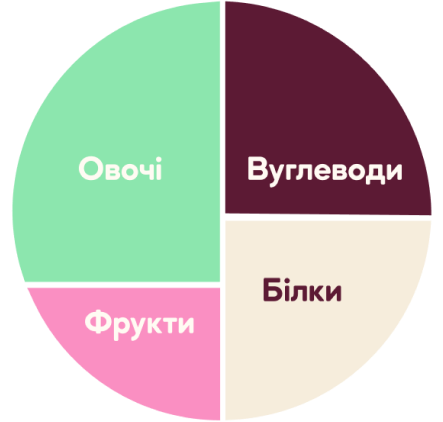
When building a healthy eating plate, divide your baby’s plate roughly into 3 parts and fill half of it, that is:
- 50% of the plate with fiber
- about 25% with carbohydrates
- and another 25% with protein sources.
In addition, offer dairy products in portions recommended for your baby’s age, and also add fats to every meal, giving preference to healthy ones, along with enough water.
More detail on each food group…
Vegetables and fruit
50% of the plate should be vegetables and fruit, as well as berries, leafy greens, mushrooms, sweet corn and green peas.
These foods are rich in antioxidants, vitamins, minerals and fiber.
The more variety, especially in color, the better. Each color contains a unique set of beneficial substances and different types of fiber, which are important for healthy work of the gastrointestinal tract and help stabilize blood sugar levels.
Fiber is also found in whole grain foods, grains, legumes, nuts and seeds. Add them to the daily diet to get even more benefit.
Carbohydrates
Set aside 25% for foods from the “carbohydrates” group — various grains, pasta, legumes, starchy vegetables, bread and baked goods, giving preference to whole grain foods.
Carbohydrates are an important part of a balanced diet, because they are the body’s main source of energy. Give preference to whole grain foods such as whole grain pasta, whole grain rice, whole grain bread, buckwheat, peas, quinoa and others.
After all, whole grain foods are made from grain that keeps all of its parts: the endosperm, the germ and the bran.
Unlike refined grains, where the bran and germ are removed, whole grain foods keep more nutrients and fiber.
Don’t forget about legumes (peas, lentils, mung beans, beans, chickpeas and others) and include them in your baby’s diet at least 2-3 times a week.
Proteins
Fill 25% of the plate with foods from the “proteins” group – meat, organ meats, fish, seafood, eggs.
Protein is the main building material for cells, tissues and organs.
It is needed for the growth and development of muscles, bones, skin and other tissues. This matters especially during your child’s periods of active growth.
Include fish in your child’s diet about 2 times a week, one of which should be an oily type (mackerel, salmon).
Don’t forget organ meats, which are an excellent source of iron (veal or pork tongue, liver, hearts, etc.).
Important: eating liver should be limited to 1 portion a week, because its high level of vitamin A can be toxic to the health of young children.
Milk and dairy products
Dairy products contain complete proteins, and they are also needed to supply the body with calcium, an important mineral for building bones and keeping them healthy.
However, the amount of dairy products in children’s diets should be kept in check, because too much calcium can interfere with the absorption of another important mineral – iron.
Children under 1 year should not be offered milk as a drink, so as not to put a load on their still immature kidneys. But you can add a small amount of milk to dishes, for example to porridge or an omelet.
Children from 1 year can be offered milk in any form, and dairy products three times a day.
1 portion of dairy products is:
- 100–120 ml of cow’s milk
- or 3 tbsp of thick yogurt
- or 100–120 ml of drinking yogurt
- or 1–3 slices of mozzarella.
Also, because children often do not get enough fat in their diet, the fat content of dairy products matters too.
Give preference to high-fat dairy products, specifically for children under 5 years more than 1% fat, and after 5 years you can offer low-fat (1%) dairy products.
Dairy products offered to children under 5 years must be pasteurized or ultra-pasteurized.
Fats
Worth offering as a portion with every meal.
Fats are extremely important, including for building the brain and nervous system in young children.
Fats are divided into saturated and unsaturated.
Saturated fats include:
- salo (cured pork fat)
- butter
- ghee
- fatty meat
- coconut products (coconut butter, coconut oil, shredded coconut).
Unsaturated fats include:
- various oils
- nuts
- seeds
- avocado
- oily fish
- cod liver.
Limit saturated fats in your child’s diet after 2 years, since eating too much of them can raise blood cholesterol and increase the risk of cardiovascular disease.
It is recommended to give preference to unsaturated fats, which are better for health.
Starting solid foods
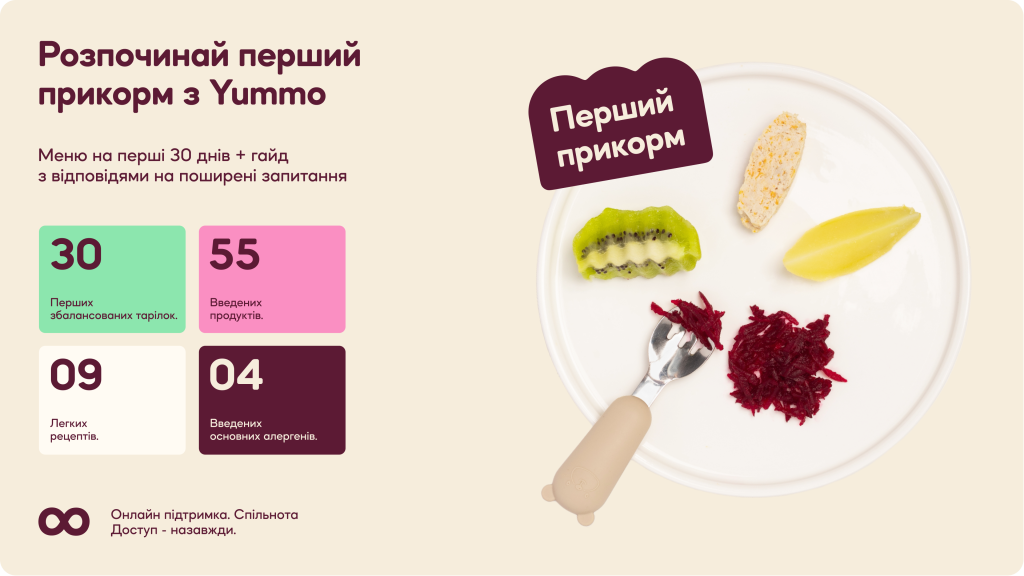
So that you don’t worry at the start of solid foods — we have created a clear, convenient eating plan for your child. We know well how many questions come up in that very first month: What do I give? How much? When? Isn’t it too early? What if there’s an allergy? That is exactly why we have gathered everything you need into one structured plan — with no unnecessary advice, confusion or stress.
The eating plan for a child 6+ months contains:
- 30 plates with photos of safe serving
- 9 simple recipes
- shopping and prep lists
- 55 foods for the start
- a guide with answers to every “what if?”
- access to a chat with experts
This is not a marathon. Not a training course. This is support.
Water when starting solid foods
Until six months, breast milk or infant formula is the only food and drink your baby needs, even in hot weather.
Breast milk/infant formula contains all the nutrients needed for your baby’s healthy growth.
Extra water can reduce your baby’s appetite for breast milk or formula, which in turn can lead to not getting enough important nutrients.
Over-diluted infant formula can harm your baby’s health by upsetting the balance of electrolytes in the body.
That is why, until 6 months, the best approach is exclusive breastfeeding, or infant formula, which covers all of your baby’s needs.
From what age can you give water
From 6 months, you can start offering your baby small amounts of water, which their body is now ready to handle. However, it is important to remember that drinking too much water still carries certain risks.
Water can and should be offered during meals, so that your baby builds the skill of drinking, and water also helps them manage some foods that are harder to swallow.
Try to keep a cup of water within easy reach for your baby at all times.
Foods and drinks to avoid
At the same time, there are foods in a baby’s solid foods that should be avoided.
Depending on your child’s age, these include:
Before 1 year
Salt
A baby’s kidneys are not yet fully developed, so they cannot remove excess salt from the body efficiently. As a result, too much salt in a young child’s diet can put an excessive load on the kidneys.
Since salt is present in many foods, it is impossible to avoid it completely. That’s why there are recommendations on safe amounts of salt for different age groups:
- under 1 year (1 g/day)
- from 1–3 years (2 g/day)
Keeping an eye on the amount of salt in your child’s diet helps avoid possible health problems in the future.
Honey, in any form
Honey can contain bacteria that can cause a serious illness, namely infant botulism.
For adults and older children these spores are safe, because their digestive system is able to neutralize them.
Honey is also a type of added sugar, so it is better to limit it in the diet until 24 months.
Any drink other than water and breast milk or infant formula
This also applies to animal milk as a drink, because too much milk in a child’s diet can contribute to iron deficiency anemia and also puts a load on the child’s still immature kidneys.
Milk can, however, be added to dishes in small amounts.
Before 2 years
Added sugar
Introducing your child to added sugar too early can create a craving for sweet foods, which can lead to them refusing more nutritious foods.
In addition, excess added sugar in the diet increases the risk of tooth decay, obesity and type 2 diabetes.
You will often come across products labeled “sugar-free,” but their ingredients actually contain added sugar under various names: sugar, honey, maple syrup, fructose syrup, glucose, fructose, sucrose, maltose, dextrose, maltodextrin.
Juices and fruit fillings also count as added sugar.
This does not apply, however, to the sugar naturally present in fresh fruit, milk and dairy products, as it does no harm to the body.
Herbal teas
Although herbal teas do not contain caffeine, they contain compounds that can interfere with iron absorption, as well as other components whose effect on a child’s body has not yet been studied enough.
So if you decide you want to give your child herbal tea, it is better to start from 2 years and in small amounts.
Under 5 years
Raw or undercooked meat, fish, seafood and eggs
Raw or undercooked foods can contain harmful bacteria, such as salmonella and E. coli.
Children are more vulnerable to these infections, which can lead to severe food poisoning.
This also applies to dishes made with them, including: poached eggs, carbonara, medium-cooked steak, homemade mayonnaise, lightly salted fish, caviar and so on.
Unpasteurized milk and dairy products
Unpasteurized milk and dairy products can contain harmful bacteria, such as salmonella, E. coli and listeria.
These bacteria can cause serious infections, which are especially dangerous for children with an immature immune system.
Aged cheeses: brie, camembert, Dorblu, Roquefort and others
Many cheeses are made from unpasteurized milk, which increases the risk of listeria infection.
So it is better to avoid such products and to check labels to make sure they are made from pasteurized milk.
However, these cheeses can be used as part of a cooked dish, since listeria is destroyed by cooking.
For example, baked brie is a safer option.
Rice milk
Because it can contain too much arsenic.
Arsenic occurs naturally in the environment, and rice usually absorbs more arsenic than other grains.
Small and hard foods
The risk of choking in children remains until about 4–5 years, so you should follow safe serving rules for small foods, as well as hard round-shaped foods.
It is worth avoiding foods such as:
- popcorn
- hard candy
- marshmallows
- round pills, and so on.
Sprouts and microgreens
Sprouts, such as soy, mung bean and others, are a popular addition to various dishes thanks to their high nutritional value.
However, eating them raw can be dangerous because of the risk of poisoning with E. coli, listeria or salmonella.
Under 12 years
Drinks with caffeine: coffee, black tea, white tea
There is no established safe limit of caffeine for children under 12 years.
On the contrary, frequent caffeine intake can interfere with the absorption of important nutrients, such as calcium and iron, which are needed for healthy growth and development.
Besides, caffeine is a stimulant that can over-stimulate the nervous system of children, leading to hyperactivity, anxiety, irritability and sleep problems.
Wild mushrooms
Wild mushrooms can be a serious threat to the health of children under 12 years — and the risks remain for adults too.
Commercially grown mushrooms, on the other hand, are a safe choice to introduce into your baby’s diet from the very start of solid foods, for example:
- button mushrooms
- oyster mushrooms
- shiitake.
In general, children should avoid
Some types of fish:
- king mackerel
- marlin
- orange roughy
- shark
- swordfish
- tilefish
- bigeye tuna.
The high level of mercury in these species can cause problems with the development of a child’s nervous system, including developmental delays and other neurological disorders.
How to reduce the risk of iron deficiency anemia
You should pay special attention to iron-rich foods, which need to be introduced from the first days of solid foods.
Because over time the iron stores received from the mother during pregnancy decrease.
Iron deficiency can lead to iron deficiency anemia, which has a negative effect on a child’s physical development and cognitive abilities.
Types of iron
It is also important to consider the type of iron.
Heme iron from animal sources, such as meat, organ meats, seafood and fish, is absorbed by the body much better than non-heme iron from plant sources, such as legumes, fortified cereals, leafy greens, seeds and nuts.
Tips for better absorption of iron from foods
Combining foods rich in vitamin C, such as fruits, vegetables and berries, increases the bioavailability of iron, especially in its non-heme form, that is, from plant sources.
At the same time, eating foods rich in calcium, which is found in the largest amounts in milk and dairy products, together with iron-rich foods can reduce the bioavailability of this mineral.
Allergenic foods
It used to be thought that you should delay offering allergenic foods in order to prevent allergies.
Parents were often in no hurry to introduce these foods into their children’s diet and might offer them after 1 year, and sometimes even after 3.
In line with the recommendations of today’s leading organizations, we recommend gradually introducing your baby to some allergenic foods before 1 year. This may help lower the risk of developing an allergy in the future.
These include the so-called “Big Nine Allergens”:
- Milk and dairy products
- Eggs and products made from them
- Cereals containing gluten – wheat, rye, barley, and products made from them
- Soy and products made from it
- Fish and products made from it
- Seafood – mollusks, crustaceans, and products made from them
- Peanut and products made from it
- Tree nuts and products made from them
- Sesame and its derivatives
Read how to introduce these foods safely in our article on food allergens.
Possible non-allergic reactions to new foods
Changes in stools once your baby starts eating
When you start solid foods, your baby’s stools change, and this is a completely normal process, because before this their food was homogeneous and liquid — breast milk or infant formula.
What other possible reactions you may notice
- Gas. A change in the diet can lead to more gas.
- Pieces of food. You may notice undigested pieces of food in the stool, especially if your baby has only just started getting solid food, and this is within the normal range.
- Diaper rash. That is, inflammation of the skin in the diaper area in babies. The main causes are prolonged moisture, friction, and contact with stool and urine. When solid foods begin, the composition of the stool changes, and prolonged contact with irritants can cause redness of the skin on the bottom. It is recommended to change diapers every 2-3 hours, rinse the affected areas with water, use zinc-based barrier creams, and leave your baby without diapers more often.
- Also, after starting solid foods, children may develop skin irritation because of the high acidity of foods. For example, after eating fruit, a rash and redness around the mouth may appear. This is not an allergic reaction but a temporary phenomenon that passes after cleaning the skin with water. The irritation does not need any special treatment.
What is the difference between allergic reactions and irritation
An allergic reaction involves the body’s immune response to an allergen, which can lead to serious symptoms such as:
- swelling
- rash
- difficulty breathing
- anaphylaxis
- as well as changes in the gastrointestinal tract
- vomiting
- diarrhea
- constipation
Irritation, unlike an allergy, usually does not involve the immune system and is a local skin reaction that has no serious consequences for your child’s health.
Are there foods that can cause diarrhea or constipation
Yes, some foods can cause diarrhea or constipation.
However, if you keep to a varied diet, the risk of such problems drops considerably.
Try not to give the same food often and in large amounts.
A varied diet not only supports good digestion but also strengthens the immune system, supports healthy development, helps prevent allergies, and builds healthy eating habits.
Your baby’s digestive system readiness for a variety of foods
When does a baby’s digestive system mature?
Introducing different food groups closer to 6 months is not a problem for the digestive system.
The available data and research indicate that kidney and gastrointestinal function are mature enough to digest the nutrients from solid foods as early as from 4 months.
In addition, the gastrointestinal tract matures under the influence of the food that is eaten.
A daily diet that includes animal-based foods, fruits, vegetables, grains, and also legumes, nuts, and seeds has a positive effect on the functioning of the gallbladder, stomach, pancreas, and intestines, and also enriches the microbiome of the whole body.
This in turn strengthens immunity.
How long and how many times to offer new foods
As of today there are no clear recommendations on how often and for how long to introduce a single food, on portion sizes, or on which food to start with.
Which food should not be introduced first
You can introduce any food into your baby’s diet, except the foods that are not allowed and those with certain limits, which were discussed above.
Everything else, including allergens, can be introduced from the very start of solid foods, in any order.
How many days to introduce a new food
New foods, even several at once, can be introduced every day.
The only exception is new allergens – it is better to introduce them one at a time, in the first half of the day, starting with a tiny amount and gradually increasing the size of the portion you offer.
If there is no allergic reaction, you need to include this food in your baby’s diet regularly.
The nutritional value of foods matters
To meet their need for energy and nutrients, children should be offered a wide range of foods with high nutritional value.
This variety not only meets their physical needs, but also builds their interest in food, reducing picky eating in the future.
Solid foods should be varied in taste, color and texture.
When you plan a meal, use the Healthy Eating Plate as your guide.
This will help you be sure that the solid foods are balanced and that your baby is getting all the vitamins and minerals they need.
Also follow the “rainbow” principle on your baby’s plate.
Offer vegetables and fruits of different colors, to add a range of vitamins and minerals to your baby’s diet.
Bright colors on the plate not only enrich the diet, they also make your baby interested in the meal, which has a good effect on their appetite.
Mixed dishes or a single food
Before you combine foods, let your baby get to know their tastes separately, without other foods or spices, offering them 2-3 times.
This helps your baby feel the pure taste of the food and gives them the chance to tell tastes apart. Draw your baby’s attention to the names of the foods by naming them.
Too little or too much? Portion size at the start of solid foods
When it comes to portion size, current recommendations stress that your baby regulates how much of a portion they eat.
This is due to the natural mechanism of self-regulation of hunger, appetite and fullness, which a baby has from birth.
Most often this perfect mechanism is disturbed by adults’ subjective judgments about how much and what a child should eat, and by food pressure in any of its forms.
What portion size depends on
So, portion size and the total calorie content of the diet depend on many factors for each child:
- age
- sex
- physical activity
- climate
- state of health
- and other circumstances.
General recommendations do exist, but they should be taken only as a guide.
In fact, no one knows exactly which portion size will be right for your child, because the need for food can change from day to day even for the same child.
Number of meals
Recommendations on the number of meals for children vary a lot, but on average these stages can be identified:
- 6-8 months – 2-3 times a day
- 9-23 months 3-4 times a day.
- 1-2 snacks are also possible, if your child needs them
How to increase portions
As you increase the number of meals, follow your baby’s interest in food.
Gradually increase portion sizes and the number of meals according to your baby’s needs, and remember that breast milk and infant formula are the main food for your baby until 12 months.
And solid foods are an introduction to new food.
Feeding schedule
It is recommended to give the first meal in the first half of the day – in the morning or at lunchtime – so that any possible negative reactions can be spotted and dealt with in time.
It is worth setting up a feeding schedule from an early age, so that meals are predictable and comfortable for your baby.
Use simple rituals, such as washing hands, saying a short rhyme or helping to set the table, depending on your child’s age.
These actions help your baby get ready for the meal.
Tell your baby in advance that the meal is about to start, so they have time to get ready and begin eating calmly.
Serving solid foods safely
Some foods can be dangerous for young children, because they are easily breathed in and block the airways.
This applies especially to children under 5 years.
Foods with a high choking hazard
Foods with a high choking hazard include:
- nuts
- all hard, small, round foods
- popcorn
- grapes
- cherries
- raisins
- olives, etc.
- raw carrot
- hard vegetables and fruits
- tough pieces of meat or cheese.
Safe ways to serve different foods
But this is not a reason to avoid these foods.
To reduce the choking risk, follow safe serving for your child’s age.
Ways to serve foods at the start of baby-led weaning (BLW), that is, when finger foods predominate, or after switching to finger foods:
- carrots, apples and other hard fruits and vegetables should be cooked until soft, peeled and served as batons or grated; sometimes you can purée them. If the vegetables and fruits are soft enough, that is, if you can squash them in your hand, then they can be served raw.
- grapes, olives and other small, round and hard foods should be cut lengthways into quarters.
- small strawberries, blueberries, bilberries, corn and cooked green peas — squash with your fingers.
- cauliflower and broccoli — cook until soft and serve as whole small florets.
- meat without small bones and skin — cook and serve cut into batons across the grain, or separated into short fibers.
- dried fruits need to be soaked in boiling water for a few minutes, and then chopped finely.
- fresh herbs — chop finely.
- fish and seafood — cook until fully cooked through and chop finely; remove the skin and bones from fish, and it can be served as a large baton.
- hard cheeses — grate them or add them to dishes.
- milk before 1 year — only add it to dishes.
- nuts and large seeds (e.g. pumpkin) — grate on a fine grater and mix into dishes (cooked porridge, yogurt, etc.).
Remember that as your child grows and their chewing skills develop, you need to change the way you serve foods, so that the food becomes firmer.
This lets your child practice their chewing skills and gradually get ready for eating from the family table, that is, food of the same texture that all the family members eat.
How to protect your child from food poisoning
Young children’s immune systems are not yet fully developed, which makes them more vulnerable to infections, including food poisoning. To avoid this, follow a few rules:
- Do not offer children foods that are not allowed for their age.
- Cook meat, fish and eggs thoroughly, so that they are fully boiled or fried through. Use a food thermometer to make sure the foods have reached a safe temperature. For meat and egg dishes this is 74°C, for fish it is 63°C.
- Always wash your hands before preparing food and after contact with raw foods. Teach children to wash their hands before eating.
- Cooked food should be cooled within 2 hours, and then stored in an airtight container in the fridge for up to 2 days.
- Defrost dishes in the fridge/cold water or in appliances on the “defrost” function.
- Regularly clean kitchen surfaces, knives and cutting boards.
- Use separate boards for raw meat and vegetables.
Sources:
https://www.cell.com/current-biology/f
https://www.ncbi.nlm.nih.gov/pmc/articles/PMC4788196/
https://nutritionsource.hsph.harvard.edu/what-should-you-eat/vegetables-and-fruits/
https://www.who.int/news-room/questions-and-answers/item/breastfeeding
https://www.nhs.uk/conditions/botulism/
https://moz.gov.ua/uk/otruennja-gribami-profilaktika-i-persha-dopomoga
https://www.cdc.gov/nutrition/infantandtoddlernutrition/vitamins-minerals/iron.html
https://www.allergy.org.au/patients/allergy-prevention/ascia-how-to-introduce-solid-foods-to-babies
https://www.ncbi.nlm.nih.gov/books/NBK148957/
https://www.rch.org.au/kidsinfo/fact_sheets/Choking_suffocation_and_strangulation_prevention/