


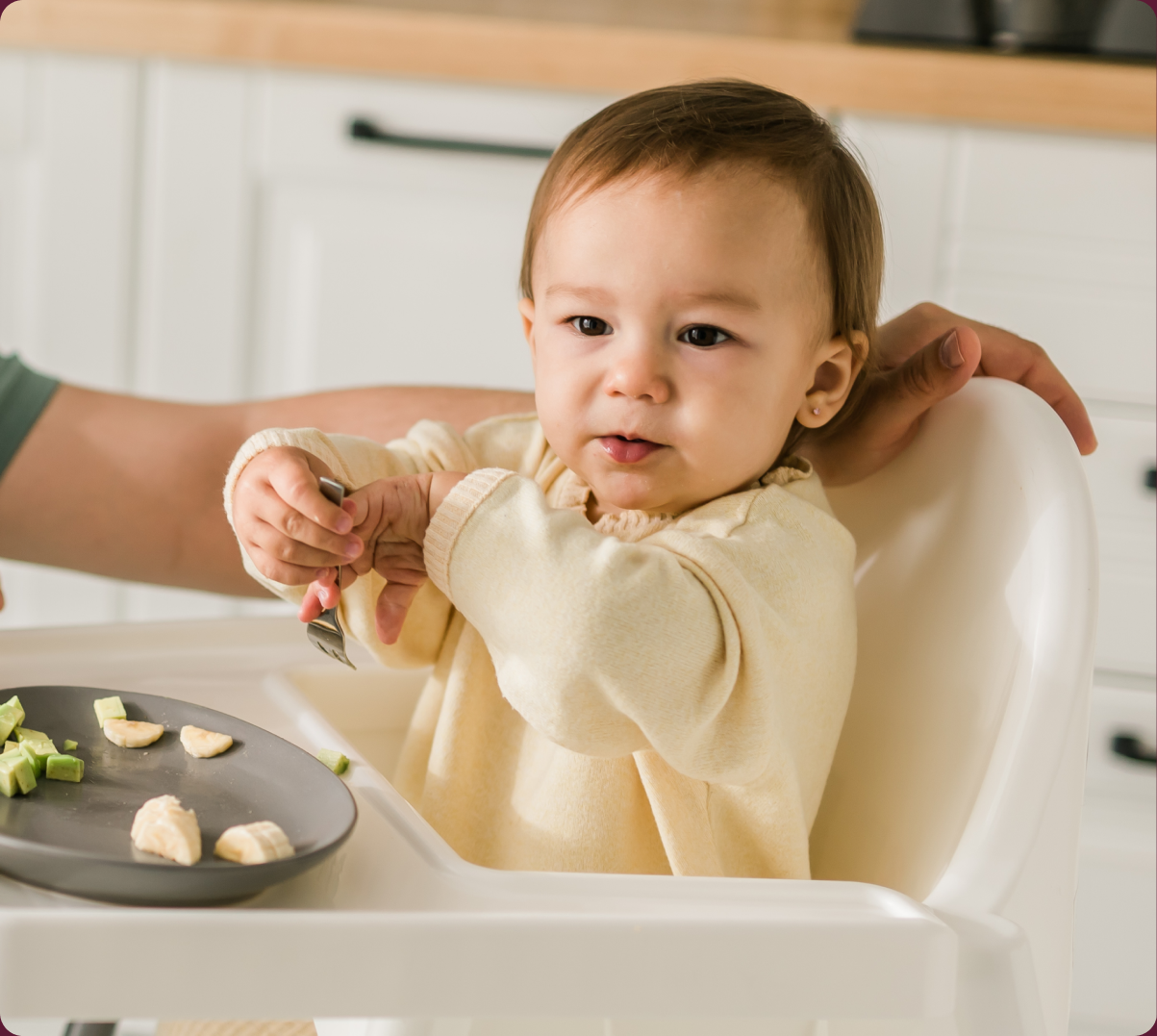
Starting Your Baby on Solid Foods From 6 Months


The stage of starting solid foods can, without exaggeration, be called one of the key stages in a person’s life, as it falls in the first years of life, when the foundations of future health are laid.
Research shows that it is during this period that your baby’s brain, body and immune system develop most actively, and starting your baby on solid foods plays an important role here.
Unfortunately, there are still many misconceptions and pieces of advice about solid foods that mislead parents.
This article, by contrast, is based on the current recommendations of leading organizations and will help you make sense of the main questions about introducing solid foods:
- when should you start solid foods?
- what should you start solid foods with?
- how do you give solid foods properly?
It will also cover a lot of important things that parents should know as they get ready for solid foods.
Contents
- What are solid foods and why does your baby need them
- The main reasons for introducing solid foods
- When to start solid foods: signs of readiness
- Starting solid foods
- False signs of readiness for solid foods
- Should you start solid foods from 4 months
- Approaches to starting solids. Which one to choose?
- Where do you start with solid foods? A food introduction table
- Portion size and feeding frequency
- Combining breastfeeding/formula feeding with solid foods
- Practical tips for successful solid foods
- Responsive feeding
- How to recognize your baby's hunger and fullness cues
- How to feed with a spoon correctly
- Solid foods and teeth
- Mesh feeder
- Red flags while starting solid foods
- Conclusions
What are solid foods and why does your baby need them
Starting solids is the process of introducing your baby to new food, other than breast milk or infant formula.
It usually begins at around 6 months, when milk alone is no longer enough to meet all of your baby’s nutritional needs.
Solid foods should be responsive, timely, safe and nutritious, and should take into account your baby’s individual characteristics and needs.
The main reasons for introducing solid foods
Providing the nutrients needed for your baby’s balanced growth and development
As your baby grows, their nutritional needs increase too.
In particular, babies’ need for iron increases after 4-6 months, when their own iron stores begin to run low.
In addition, after 6 months breast milk or infant formula no longer provides enough energy, protein, zinc and some other nutrients, which your baby should get from solid foods.
Moving to the family table
Solid foods help your baby move gradually from an all-milk diet to a varied family diet.
Building healthy eating habits
Early experience of different tastes, aromas and textures helps build healthy eating habits for the future.
Developing chewing and speech skills
Foods of different textures and consistencies help children learn to chew and develop the jaw and tongue muscles, which is an important part of developing the mouth’s motor functions, and these directly affect speech skills.
Chewing also helps form a correct bite and strengthens the jaw joints.
Social development
Meals shared with the family have a positive effect on family relationships and help your baby get used to family traditions.
Shared meals are also essential for developing children’s communication and social skills, as they watch other members of the family.
Preventing allergies
Current guidelines indicate that introducing a wide range of foods, including the most common allergens, before 12 months of age may help reduce the risk of developing food allergies in the future.
Maturing of the digestive tract
After 4 months your baby’s digestive system is ready to digest non-milk food, and importantly, the digestive tract matures thanks to solid foods.
When to start solid foods: signs of readiness
The World Health Organization, the American Academy of Pediatrics, the UK’s National Health Service and many other organizations advise starting solid foods at around 6 months of age.
Before this age, breast milk or infant formula is usually enough.
However, besides age there are other signs of readiness for solid foods, and together they show that your baby can now be introduced to solid foods.
These include:
- Being able to hold their head steady and sit upright, with support or on their own.
- Well-developed eye, hand and mouth coordination. Being able to pick objects up with their hands and bring them to their mouth shows that the motor skills needed for self-feeding are developing.
- The tongue-thrust reflex fading. Your baby may still push food out, because the right chewing movements take some practice. But your baby is more likely to swallow food than to automatically push everything back out.
- Interest in food. Your baby shows active interest in the foods adults are eating. They watch, try to grab food, or open their mouth and lean forward when food is offered.
Starting solid foods
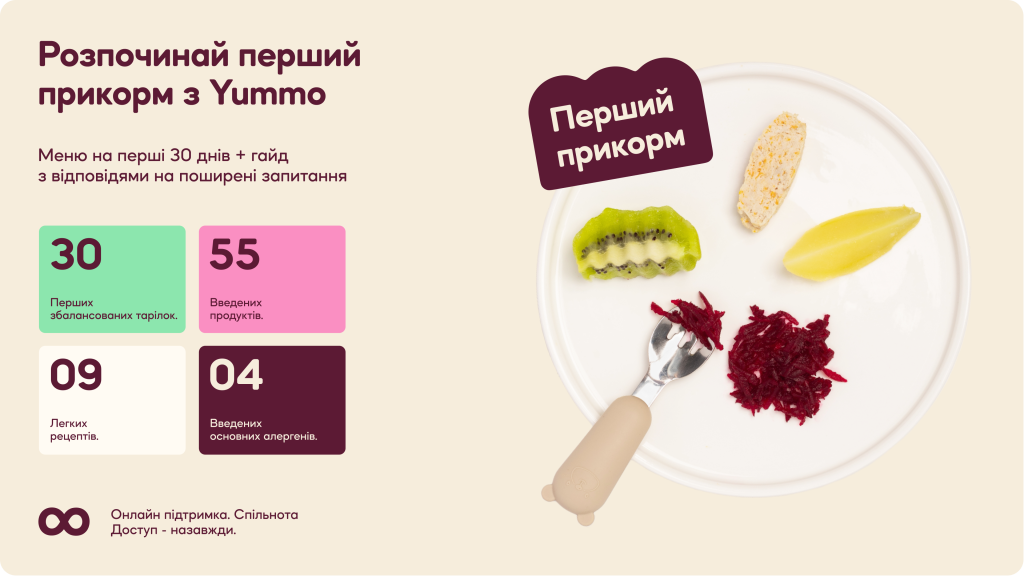
So that you don’t worry at the start of solid foods, we have created a clear, easy-to-use meal plan for your baby. We know very well how many questions come up in that very first month: What should I give? How much? When? Is it too early? What if there’s an allergy? That’s why we have gathered everything you need into one structured plan — with no unnecessary advice, confusion or stress.
The meal plan for a baby 6+ months includes:
- 30 plates with photos of safe serving
- 9 simple recipes
- shopping and make-ahead prep lists
- 55 foods to start with
- a guide with answers to every “what if?”
- access to a chat with experts
This is not a marathon. Not a training course. This is support
False signs of readiness for solid foods
However, there are certain states and situations that are often taken as criteria of readiness for solid foods, but in fact they should not influence the decision to start solid foods.
The most common false signs of readiness for solid foods include:
Your baby’s weight
Doubling their weight can point to healthy growth, but it is not a criterion for starting solid foods.
Low weight or rapid weight gain needs the cause to be found, and solid foods are not the way to correct it.
Frequent night waking
More frequent waking at night does not necessarily mean your baby is ready for solid foods.
The reasons can vary, including changes in the daily routine, developmental periods, or teething.
More breast milk or formula feeds
Frequent feeding is not a sign that solid foods are needed; it may reflect a change in your baby’s needs that milk meets.
Chewing on their fists
This is normal behavior and does not show readiness for solid foods.
Your baby may chew on their fists because of teething, or because of hunger that milk satisfies. It can also simply be a normal way of exploring the world and their own body.
The first teeth appearing
Usually, the first teeth can appear anywhere between 4 and 18 months.
The main chewing work is done by the molars and premolars, which come in after 1 year. Before that, your baby can chew soft food with their gums even without teeth.
Pressure from family or society
Advice and expectations from the people around you should not determine when you start solid foods.
Instead, go by your baby’s individual signs of readiness and current recommendations.
Also, when deciding about starting solid foods, remember that starting too early or too late may affect your child’s health and development later on:
- Starting solid foods too early (before 4 months) can lead to reduced milk supply, not getting enough nutrients, digestive problems, a higher risk of infections, allergies, choking and obesity.
- Starting solid foods too late (after 6-7 months), on the other hand, can cause growth delay, a higher risk of allergies, chewing problems, and low interest in food.
Important!
For babies born prematurely, solid foods should be started taking corrected age into account and individual signs of readiness.
In this case you need to go by motor development, interest in food, and the recommendations of healthcare professionals.
This approach helps make the move to the new stage of feeding safe and comfortable for a baby born prematurely.
Should you start solid foods from 4 months
Some organizations, such as ESPGHAN, state that the minimum acceptable age for starting solid foods is 4 months.
However, they also add that for most babies the desirable goal is feeding exclusively with breast milk, or with infant formula, for the first 6 months.
Besides, it is worth remembering that, apart from age, there are other criteria for your baby’s readiness for solid foods, which are mentioned above.
Going by these criteria, few babies are already ready for solid foods at 4 months; usually this happens closer to 5-6 months.
In certain situations starting solid foods at 4 months is appropriate, but it should be a considered decision made together with your pediatrician, taking into account your baby’s individual needs and health.
Such a case is more of an exception to the rule than standard practice.
So we can conclude that reaching the age of 4 months by itself should not prompt you to start solid foods if your baby is not yet showing other important signs of readiness.
Approaches to starting solids. Which one to choose?
Today there are two main approaches to starting solid foods: baby-led weaning (BLW) and traditional solid foods in the form of purées.
The choice of approach depends on what is possible, on the mother’s psychological readiness (or that of others who feed the baby) and, most importantly, on your baby’s individual traits and readiness.
Some babies like to start with mashed, lumpy food, or with food in pieces they can hold in their hands.
Others need more time to get used to new textures, so at first they may prefer food with a smooth, even consistency, with no lumps or pieces.
Whatever type of solid foods you choose, it is important to offer your baby a variety of foods, to take their individual needs into account and to follow the principles of responsive feeding.
You can learn more about these aspects in the following sections.
Where do you start with solid foods? A food introduction table
According to the recommendations of leading organizations such as the UK’s National Health Service (NHS), the World Health Organization (WHO) and the European Society for Paediatric Gastroenterology, Hepatology and Nutrition (ESPGHAN), there is no scheme or table for introducing foods in your baby’s first solid foods.
The main principles of starting solid foods are based on your baby’s needs and readiness, and on offering varied, adequate and safe foods.
The choice of first foods depends on family traditions, where you live, the family’s financial situation, and some other factors.
Still, a few general recommendations about first solid foods are worth highlighting.
For example, according to the WHO, infants and young children aged 6–23 months should eat a variety of foods from all food groups.
Their daily diet should include animal-source foods, fruits, vegetables, grains, fats, and should often include legumes, nuts and seeds.
All of the above, served safely.
A varied diet helps give your baby the energy and nutrients they need, including iron and zinc, to support healthy growth and development.
A monotonous diet, on the other hand, raises the risk of nutrient deficiencies and encourages picky eating.
As for the order of introducing foods, you can introduce any number of new foods at a time and in any order, except for the foods that are the most common allergens.
These foods include milk, eggs, soy, cereals containing gluten, tree nuts, peanuts, fish, seafood and products made from them.
The main allergens should be introduced before 1 year, but it is best to introduce them separately from one another, starting with small amounts of one new food and watching your baby’s reaction.
This approach makes it easier to spot which of the potential allergens is causing an allergic reaction.
Read more about the best first solid foods, drinks in your baby’s diet, building a balanced plate, and foods to avoid in our article 100 First Foods.
And if you find it helpful to have some reference points when introducing solid foods, then instead of rigid tables we suggest using our flexible First 30 Plates menu.
Portion size and feeding frequency
When you start solid foods, begin with 1–2 teaspoons of food once a day.
At first your baby may only taste the food and may not swallow much. But don’t worry about how much they eat.
The most important thing is to introduce your baby to new tastes and textures, and to teach them to chew and swallow food.
As your baby grows, you can gradually increase the amount of food in line with their appetite, following their hunger and fullness cues.
The WHO suggests the following number of meals:
- 6–8 months – 2–3 times a day;
- 9–23 months – 3–4 times a day, plus 1–2 nutritious snacks if your child needs them.
Combining breastfeeding/formula feeding with solid foods
The American Academy of Pediatrics, the WHO and other organizations recommend exclusive breastfeeding for the first 6 months of a baby’s life.
There is no need to deliberately replace one milk feed with solid foods, because before 1 year breast milk or infant formula will remain the main source of energy.
Watch your baby – as they get older they will eat more solid foods, and milk feeds will gradually decrease naturally.
So, at around 12 months solid foods will make up the larger part of your baby’s diet.
After 12 months your child no longer needs infant formula, but you can continue breastfeeding until two years or longer, if you and your child wish to.
Breastfeeding remains beneficial for mother and child throughout this whole time, not only in the first 6 or 12 months.
In general, before you offer food your baby should not be too hungry or too full after a milk feed.
So a milk feed, breast or formula, can be 2–1.5 hours, or even 30 minutes, before solid foods – this needs to be worked out individually, depending on your baby’s needs.
A milk feed can of course be offered right after solid foods, if your baby shows signs of hunger.
Practical tips for successful solid foods
The following recommendations will help support your baby’s healthy growth and development, and build a positive attitude toward food, whichever method of starting solids you choose:
Keep your baby’s diet varied
During the first weeks and months after starting solid foods, babies should be introduced to a variety of tastes. This helps to build healthy taste preferences.
Make sure conditions are comfortable and the position is right
Choose a time when your baby is not too tired or too hungry, so they can concentrate.
Keep mealtimes calm and enjoyable, with no distractions such as the TV or other devices.
Your baby should sit upright in a high chair or on an adult’s lap. Their position should be stable, so that they can move their arms freely.
Feeding your baby lying down, reclined, or on their tummy is dangerous.
Let your baby explore food and feed themselves
Talk to your baby about the foods they are eating — what it is, what color it is, what it tastes and feels like.
Don’t stop your baby from exploring food with their hands and feeding themselves once they show interest.
Encourage your baby to touch food, to squash and smell it, to dip their hands into purée, to lick their fingers and to interact with food in other ways.
Exploring food with the hands — squashing, rubbing, squeezing — is an important stage in your baby’s development, because it supports sensory perception, sparks curiosity about new foods and helps develop fine motor skills.
This kind of tactile “tasting” with palms and fingers has a positive effect on your baby’s willingness to try that food later on.
Listen to your baby
Don’t rush your baby or distract them, and never force them to eat.
Be patient and give them as much time as they need.
Don’t use food as a reward or a punishment.
Stock up on patience
Keep offering a variety of foods, even the ones they don’t seem to like.
Your baby may need 10-20-30 tries to get used to new foods, tastes and textures.
On some days children eat more, on some days less, and sometimes they refuse food altogether.
Don’t worry, this behavior is normal.
It is also completely natural for babies to pull funny faces while trying new food. These expressions can mean different things: your baby may be surprised, confused or unsure about the new taste.
Eat together whenever you can
Family meals together support social interaction and copying the eating habits of adults.
During shared meals children learn to interact with others, to watch their behavior, to chew and to communicate.
Offer food from the family table
Let your baby try your food, so they get to know the tastes of your usual home-cooked meals.
Don’t refuse if your baby wants to share something from their own plate with you.
These actions support interest in food and help build trust in food.
So starting solid foods is a good chance for you to rethink your own diet, to set a healthy example for your baby and to enjoy the same family meals together, taking into account safe serving and foods allowed for their age.
Moving on to finger foods at the right time
If you have chosen to start solid foods with purées, it is important not to stay at this stage for too long.
Moving on to finger foods at the right time matters for developing chewing and speech skills, and it also supports good eating habits.
Children can manage soft finger foods even if they don’t have teeth yet, because gums can also chew food effectively.
Ideally, make this transition by 9-10 months.
However, if your baby has difficulty moving on to new textures, it is important to do it gradually, to avoid choking and to keep your baby comfortable.
Take care of safety
Learn to tell apart situations where your baby is gagging from times when your baby is choking and you need to act.
Before you start solid foods, make sure you learn first aid for choking:
Always watch your baby while they eat, to prevent choking.
Do not feed your baby on the move, and do not let them crawl or walk with food in their mouth.
Food must be the right size, shape and texture to avoid choking, and it must not be too hot, to avoid burns.
Do not offer your baby foods that are not recommended for their age.
Proper storage and preparation
Before preparing food and feeding your baby, wash your hands thoroughly with soap. Use clean kitchen surfaces and clean tools to prepare food.
Cook with fresh, good-quality ingredients.
Use clean drinking water for cooking and for drinking.
Avoid food that may have been contaminated or spoiled.
These food safety steps will help protect you from food poisoning caused by pathogens that food can contain.
Take your baby’s own features into account
Every child is unique.
What suits one may not suit another.
Listen to your baby and watch them, adapting the process of starting solids to their individual needs.
Responsive feeding
It is important to learn to recognize your baby’s hunger and fullness cues and to feed according to them.
This approach, known as “responsive feeding”, helps build healthy eating habits, supports a healthy weight and makes it easier to accept new foods and textures.
In addition, responsive feeding strengthens the emotional bond between parents and child, providing support and security during feeding.
Creating a calm and supportive environment during feeding helps reduce the stress linked to eating, and builds positive associations with food.
When your child feels comfortable and safe, they enjoy eating more, which helps them accept a wider range of foods.
The effectiveness of responsive feeding is confirmed by numerous studies.
How to recognize your baby’s hunger and fullness cues
Hunger and fullness cues in babies and young children during the move to solid foods can vary, and they often differ depending on age and on the child’s individual features.
Watch your own baby to understand exactly how they signal fullness and hunger.
Main hunger cues in a baby:
- Increased activity or restlessness in your baby.
- Opening their mouth and leaning their head forward as the spoon comes closer.
- Wanting to eat by themselves.
- Your baby reaches for food or points at food.
- Your baby shows enthusiasm, excitement or impatience at the sight of food.
- Your baby makes sounds that may mean they want to eat.
Main fullness cues in a baby:
- Pushing food away.
- Pressing their lips together or turning their head away from the food.
- Losing interest in food, getting distracted by other objects or activities, wanting to get down from the chair.
- Getting upset and angry when food is offered.
How to feed with a spoon correctly
The right spoon-feeding technique builds positive associations with food.
That is why it matters not only what you feed your baby, but also how exactly you do it.
Follow these recommendations:
- Put a small amount of food on the front of a soft, flat spoon. It is important that your baby sees the food they are being fed.
- Bring the spoon up to your baby’s mouth, at eye level, and wait until they open their mouth or lean forward.
- Gently place the spoon in your baby’s mouth and let them take the food off with their lips.
- Give your baby time to taste and swallow the food. If your baby reaches for the spoon — wonderful! Let them try to guide the spoon to their mouth themselves.
- Repeat the previous steps until your baby shows the signs of fullness listed above.
Not recommended:
- Do not tilt the spoon upward too much, as this will not teach your baby the right eating technique.
- Do not touch the roof of the mouth or the upper lip with the spoon.
- Avoid scraping food off the lips and chin with the spoon. This can lead to a negative attitude toward feeding.
- Do not trick or distract your baby into opening their mouth (with cartoons, airplanes, other food). Never put the spoon in without them being aware of what is happening.
- Do not rush; give your baby time to deal with the food and to recognize the feeling of fullness.
- Follow your baby’s cues, and do not force them to finish the last few spoonfuls.
Solid foods and teeth
A common belief is that a baby should not be given food as finger foods until they have teeth.
However, this is a misconception, because the first teeth to come through in babies are the incisors, which only help with biting, not chewing.
The chewing teeth — the molars — usually appear after 1 year.
In general, the first chewing movements can be noticed in a baby at 4-5 months, and a full set of teeth is not formed before 2-3 years.
Throughout this period children use their gums effectively to break down and chew food, so it is important to offer food in a safe form even before the first little teeth appear.
So, to start solid foods in pieces you do not need to wait for your baby’s teeth to appear, and you should not treat the appearance of teeth as a criterion of readiness for solid foods either.
Mesh feeder
A mesh feeder (nibbler) is a popular device consisting of a handle and a mesh or silicone pouch, into which pieces of food are placed, usually fruit or berries.
Your baby can chew the food through the mesh feeder, getting small portions of mashed food with a minimal choking risk.
For this reason a mesh feeder may seem like a useful and even essential device for starting solids, but it does more harm than good.
It is worth noting, though, that sometimes a mesh feeder can be used as part of feeding therapy, but only under the guidance of a specialist.
Potential problems from using a mesh feeder
Missing chewing skills
A mesh feeder (nibbler) does not teach your baby to chew properly or to move food around the mouth, which can make the move from puréed food to pieces of food harder.
More picky eating
Using a mesh feeder limits your baby’s experience of different food textures, because the device mostly releases a uniform liquid.
When food comes from a mesh feeder, your baby has no way of seeing what the food they are offered looks like.
Later on this can lead to picky eating, where your child avoids unfamiliar foods or textures.
Delayed self-feeding skills
A mesh feeder can delay the moment when your baby learns to hold food and eat with their hands, which is an important step in becoming independent.
Breastfeeding problems
Using a mesh feeder can affect how your baby behaves during breastfeeding.
If your baby gets used to getting food easily and quickly from a mesh feeder, they may show less interest in breastfeeding, where more effort is needed to get milk.
A mesh feeder can encourage the habit of biting to get food, and this can lead to your baby starting to bite during breastfeeding too.
Hygiene problems
A mesh feeder is hard to clean completely, so it can become a place where bacteria multiply, raising the risk of infections and other illnesses.
Risk of tooth decay
Frequent use of a mesh feeder with fruit and berries can raise the risk of tooth decay in young children, because the teeth are in constant contact with sugar and fructose.
Red flags while starting solid foods
Starting solid foods is an exciting event in your baby’s life, and it does not always go smoothly.
Your baby’s appetite can vary under the influence of different factors, and that is completely normal.
But sometimes certain situations can signal a problem and call for a visit to a pediatrician who specializes in children’s nutrition.
The following cases need immediate attention
- Ongoing poor weight gain (a drop in percentile on the growth chart) or weight loss that is not linked to an acute illness
- More than one episode of nasal reflux (vomiting or spit-up coming through the nose)
- Diarrhea or constipation
- Blood appearing in the stool
- Repeated episodes of choking, gagging or coughing while eating
The following situations also need assessment by a specialist
- Aversion to or avoidance of foods with a certain texture (puréed, crunchy and so on) or of a food group (meat, vegetables, grains and so on)
- Difficulty moving on to pieces of food
- No interest in food after 7 months
- Crying or arching the back during or after eating
- Persistent refusal to eat
- Your child eats only with cartoons, books or other distractions
- Your child eats only puréed food and only from a bottle
- Meals turn into a battle, and you are constantly thinking about how to get your child to eat
- At 12 months, breastfeeding/formula feeding still clearly outweighs solid foods
Conclusions
Solid foods are new types of food introduced in addition to your baby’s usual milk feeds.
The purpose of solid foods covers far more than simply providing the nutrients your baby needs.
Starting solids is an important stage in your baby’s life, and it affects their psychological and physical development. It also plays an important role in shaping their overall health and their eating habits for life.
Reaching the age of 4 months on its own should not prompt you to start solid foods if your baby is not yet showing other important signs of readiness.
Leading organizations recommend starting solid foods at around 6 months.
Besides age, important signs that your baby is ready for solid foods are being able to hold their head steady, sit with or without support, pick things up with their hands and bring them to their mouth, the fading of the tongue-thrust reflex, and an interest in the food adults are eating.
The choice of method for introducing solid foods depends on what the people feeding your baby are able to do and how comfortable they feel about it, and above all – on your baby’s individual features and readiness.
With any type of solid foods, it is important to offer safe and varied food, to take your baby’s individual needs into account, and to follow the principles of responsive feeding.
According to the recommendations, there is no specific scheme or table for introducing solid foods.
The choice of first foods depends on various factors, but it is important to provide a diet that includes foods from all food groups. This will help avoid the risk of nutrient deficiencies and of picky eating developing.
Before 1 year, solid foods should not displace breastfeeding or adapted infant formula, since they remain your baby’s main source of energy.
When you start solid foods, begin with 1-2 teaspoons of food once a day, to introduce your baby to new tastes and textures and to teach them to chew and swallow food.
The amount of food increases gradually in line with your baby’s appetite, guided by their hunger and fullness cues.
Introduce your baby to a variety of tastes as you start solid foods, and provide calm, comfortable conditions for feeding.
Let your baby explore food on their own, be patient, and gradually move on to pieces to develop their chewing skills.
It is important to learn to recognize your baby’s hunger and fullness cues and to feed them accordingly.
Responsive feeding supports the development of healthy eating habits and also strengthens the emotional bond between parents and child.
Good spoon-feeding technique builds positive associations with food. It is important to pay attention not only to what you feed your baby, but also to how you do it.
You do not need to wait for your baby’s teeth to appear before offering finger foods, and having teeth is not a criterion of readiness for solid foods.
Despite its popularity, a mesh feeder does more harm than good: it can create problems with breastfeeding, delay the development of chewing and self-feeding skills, increase picky eating, pose hygiene risks, and carry a risk of tooth decay.
Your baby’s appetite can fluctuate under the influence of various factors, which is normal, but sometimes it can point to problems that require a visit to a pediatrician who specializes in feeding issues in children.
Sources:
https://www.pregnancybirthbaby.org.au/the-first-1000-days
https://www.who.int/publications/i/item/9789240081864
https://pubmed.ncbi.nlm.nih.gov/28027215/
https://www.allergy.org.au/images/pc/ASCIA_PC_How_to_Introduce_Solid_Foods_FAQs_2024.pdf
https://www.nhs.uk/start-for-life/baby/weaning/
https://www.nhs.uk/conditions/baby/weaning-and-feeding/babys-first-solid-foods/
https://www.betterhealth.vic.gov.au/health/healthyliving/eating-tips-for-babies
https://www.cdhp.org/can-babies-chew-without-teeth/
https://www.who.int/health-topics/complementary-feeding
https://www.nhs.uk/start-for-life/baby/weaning/safe-weaning/choking-and-gagging-on-food/
https://www.who.int/activities/promoting-safe-food-handling